The Block · PUBLISHED 8 OCTOBER 2026
The middle of the trip
A friend's trip to Northern Ireland sent me back to a 2018 drive from Munich to Lake Como, and to the Austrian town my grandfather wrote home from in May 1945.
A friend of mine left for Ireland and is currently traveling in the Northern part of Ireland - she knows she has ancestors that came from Scotland and Northern Ireland, but she doesn't know who - and it sent me back to a trip of my own eight years ago at this time.
In 2018 my husband and I drove from Munich, Germany to Lake Como, Italy with friends. The trip was planned around three things. We would start at Oktoberfest in Munich. We would end on Lake Como. And the middle, which could have been anything, was chosen by my grandfather.
The letters
About a year before the trip I had been reading my grandparents' letters from World War II (WWII), helping my mom sort, organize, preserve and digitize them. My grandma typed all her letters and kept a carbon copy of every one she sent to my grandpa, and she kept the letters my grandpa sent back. So we had both sides of the conversation, which families rarely get - how ingenious of her! Over 265 letters written between them, from January 12, 1944 after he was enlisted with a few postcards scattered within the letters - to his last letter dated June 11-12, 1945 which shared brief details of the war being over, that my grandma shouldn't write any more letters because he will probably be on his way home, and how much he was looking forward to being home in Chicago!
In with one of the letters was a picture postcard of Landeck, a town in the Tyrol in western Austria, where my grandpa wrote that he had stayed during his service in the Army. In his letter he shared, "you will notice a spiral of smoke coming from the large building on the left hand side. That is where we were quartered up until a few days ago. We since have been moved to the barracks that are shown on the left hand side of picture no. two. The large building in the center of the picture is an old castle. The road that can be seen going around the mountain is the only way from there to Italy. Going back to Germany uses the same road only in the opposite direction." If you look closely at postcard no. 1, he marked an arrow in black pen above the spiral of smoke coming from the building.
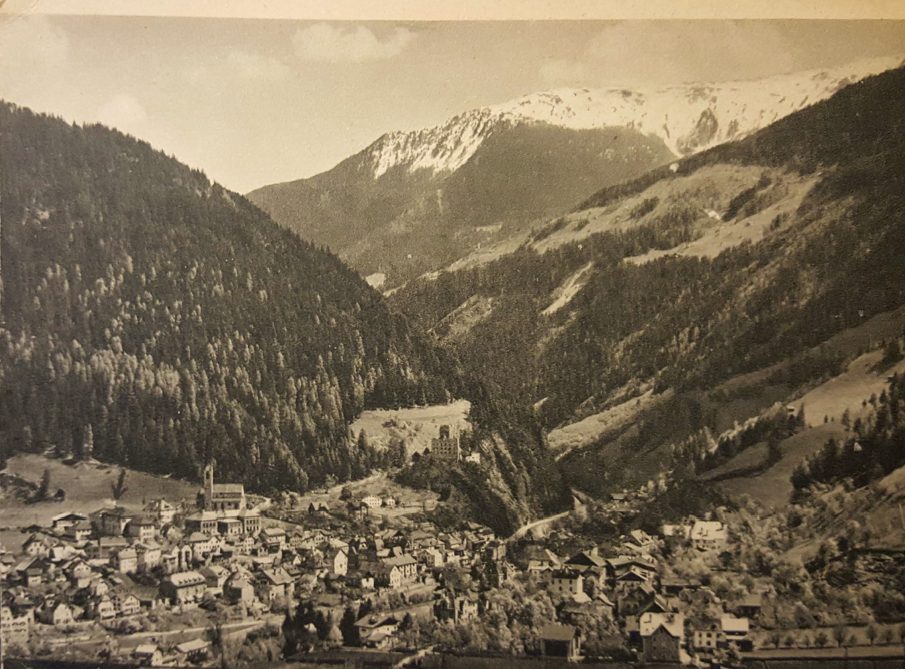
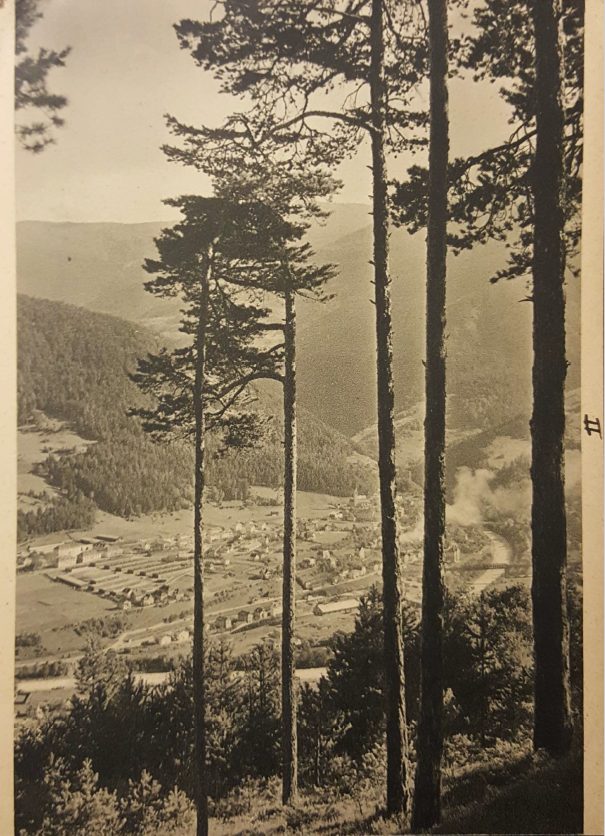
A wartime letter usually could not say where it was written. Every envelope went past an Army examiner first — his are stamped Passed by U.S. Army Examiner — and place names did not get through. That changed when the war in Europe ended on 8 May 1945. Five days later, on Sunday 13 May, he wrote:
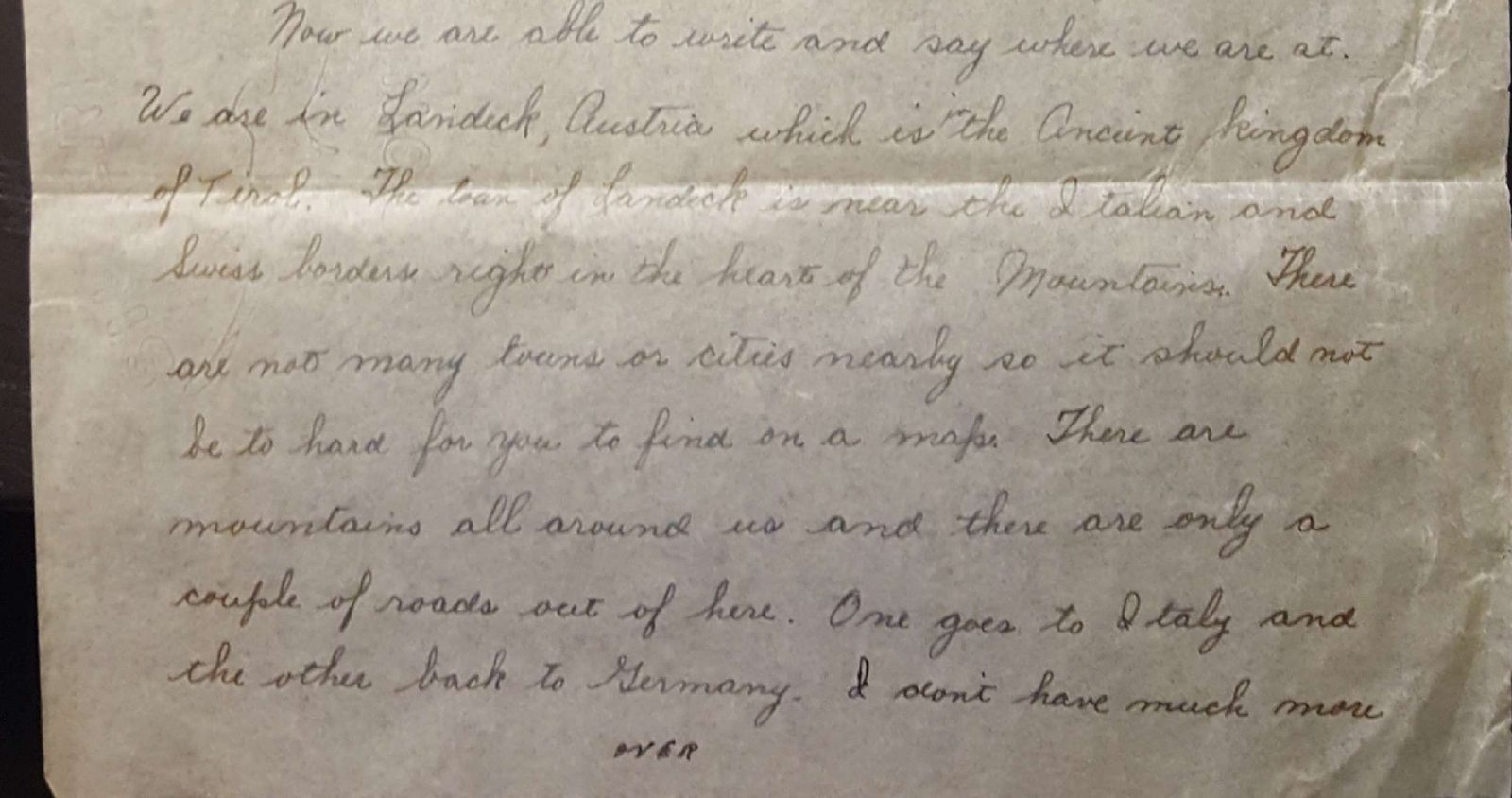
"There are mountains all around us," he went on, "and there are only a couple of roads out of here. One goes to Italy and the other back to Germany."
Landeck sits where the road up the Inn valley turns south toward the Reschen Pass and Italy — his road out — and where the road west toward the Arlberg, Liechtenstein and Switzerland begins. That was ours. The two met in Landeck.
So the middle of the trip became a question: how much of his road could we drive on our way from Munich to Lake Como?
Following him on paper
Answering that meant building his war on paper before I could drive any of it.
The record that should hold the most is the one most likely to be gone. In 1973 a fire at the National Personnel Records Center in St. Louis destroyed about 80 percent of the personnel files for Army soldiers discharged between 1912 and 1960. Fortunate again, my grandparents saved all his paperwork, so we have more than what you would get from National Personnel Records Center in St. Louis based on what remains from the fire.
Like the Chicago fire of 1871, it changes the route, not the destination. Once you know the unit, the unit's own records take over:
- The division and regimental histories. Many were printed right after the war for the men who served, and they follow the unit almost day by day: which town, which river, which pass. My grandpa was in the 44th Infantry Division, Company F of the 324th Infantry Regiment and we had his military books.
- Morning reports. The daily company rosters, held at the same records center, record who was present, who was sick, who was transferred. They were not part of the fire.
- Unit journals and after-action reports, at the National Archives, for the detail the printed histories leave out.
The morning reports, unit journals and after-action reports I have not done yet; they are on my to-do list.
There were too many places from his travels that lined up with our route to cover them all here, so maybe I'll go back to my notes and write about them in an upcoming post.
Since he was clear in his letters, in pre-planning, I chose 4 or 5 places that might align with our drive to Lake Como, but specifically chose Landeck as a place to stop because of his letters, the postcards, him marking the buildings on the postcards as well as the view from the hill looking down on the town.
If you try this yourself, keep two kinds of line on the map. A letter's date and a unit's position can place a man with some confidence, but it is still an inference, not a record that names him. Draw what the records show as a solid line and what you are inferring as a dashed one, and you will always know which is which. I used Google maps to map out his route versus our route to see what worked for us as we traveled from Munich to Lake Como.
Landeck, May 1945
The regiment's own record fills in what his letters could not say. His division was the 44th Infantry; in its last drive into the Alps the 324th Infantry Regiment came through the Fern Pass, cleared Imst and occupied Landeck on 5 May 1945, three days before the war in Europe ended.
My grandpa kept his copy of the Combat History of the 324th Infantry Regiment, and it records the arrival hour by hour. At 20:00 on 5 May, the First Battalion and the regimental command post closed into Landeck. The German 19th Army surrendered in that sector the same day, and the regiment used the town's school and municipal buildings to handle the thousands of men coming in. Attached units joined them, among them Company C of the 772nd Tank Battalion, attached to the 324th since March, and moved into the German army barracks in and around the town. The days after were what the history calls police work: roadblocks, rounding up German stragglers, and turning the barracks into somewhere an army could live while it waited to go home.
That is the school he wrote from on 15 May, and the barracks he moved into before 19 May. The letters and the regimental history tell the same story from two sides.
The drive - September 30, 2018
Our trip started in 3 different places, Venice for us, Amsterdam, and London. Our meet up was Munich for Oktoberfest, our first night, dinner and beer at the Hofbräuhaus. Day two would bring us to the Oktoberfest grounds. It was much bigger than I thought it was going to be, lots of people, beer, dancing, food, and fun! We celebrated being together at Oktoberfest to start our two-week trip. Brandon, me, my husband Don, and Betina enjoying our liters of beer!
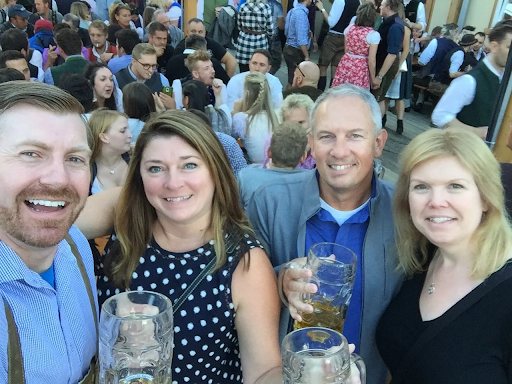
After a couple of days in Munich, we started our drive down to Italy, heading south out of Munich, into the mountains. Sunday 30 September — up at 5:30am, on the road at 7am we had a full day of driving and sightseeing along the way. We had one major stop, Landeck, before reaching Lake Como.
Landeck, Austria
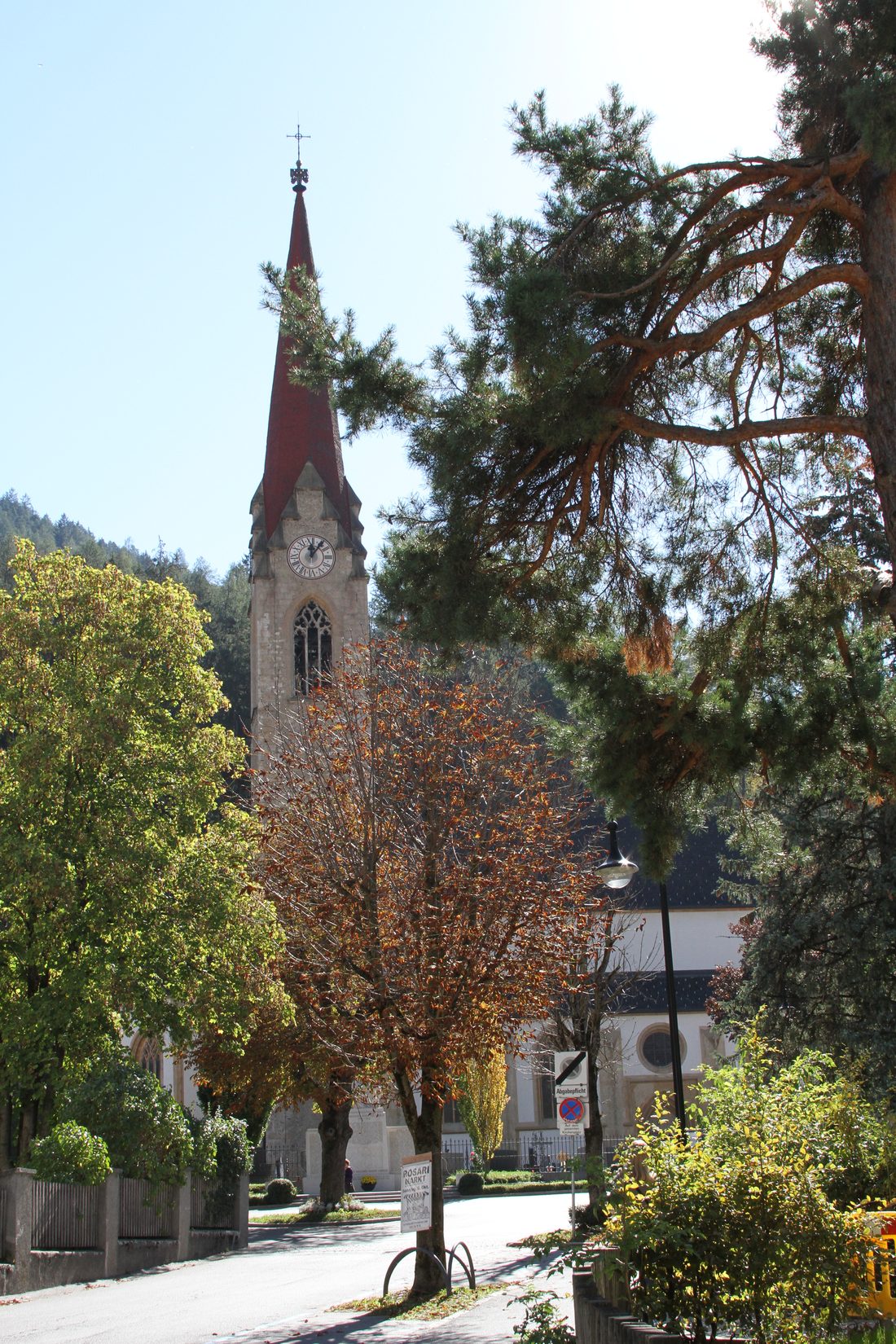
Our drive to Landeck was quite nice. Once we arrived we had four locations I wanted to see, the church, the school, the barracks and the view that my grandpa wrote about and marked on the postcards. First we drove through the town itself, it was a beautiful day, sunny and warm. It was a Sunday, and Sundays are traditionally preserved as a day of rest and family time in Austria, so that meant all the shops were closed, I had hoped to see some shops and get something to remember our stop with. Landeck is very hilly and reminds me of the Pacific Northwest here in the states. Much of that region and our drive was very hilly, winding roads and lots of trees.
The church and the castle
My grandpa used the church and the castle as markers to describe where the school and the barracks were located in his letters to my grandma. There was no other significance. They had a chaplain with them in his infantry, and they weren't able to go in places per his notes in his letter.
The school
For the first weeks of peace his company was quartered in a school. On 15 May he wrote: "We are not doing much except stay near our school building. We are allowed to walk around the town from seven to nine in the evenings. But, we can't stop in for a short beer or buy anything as the stores are closed and the M.P.s are around."
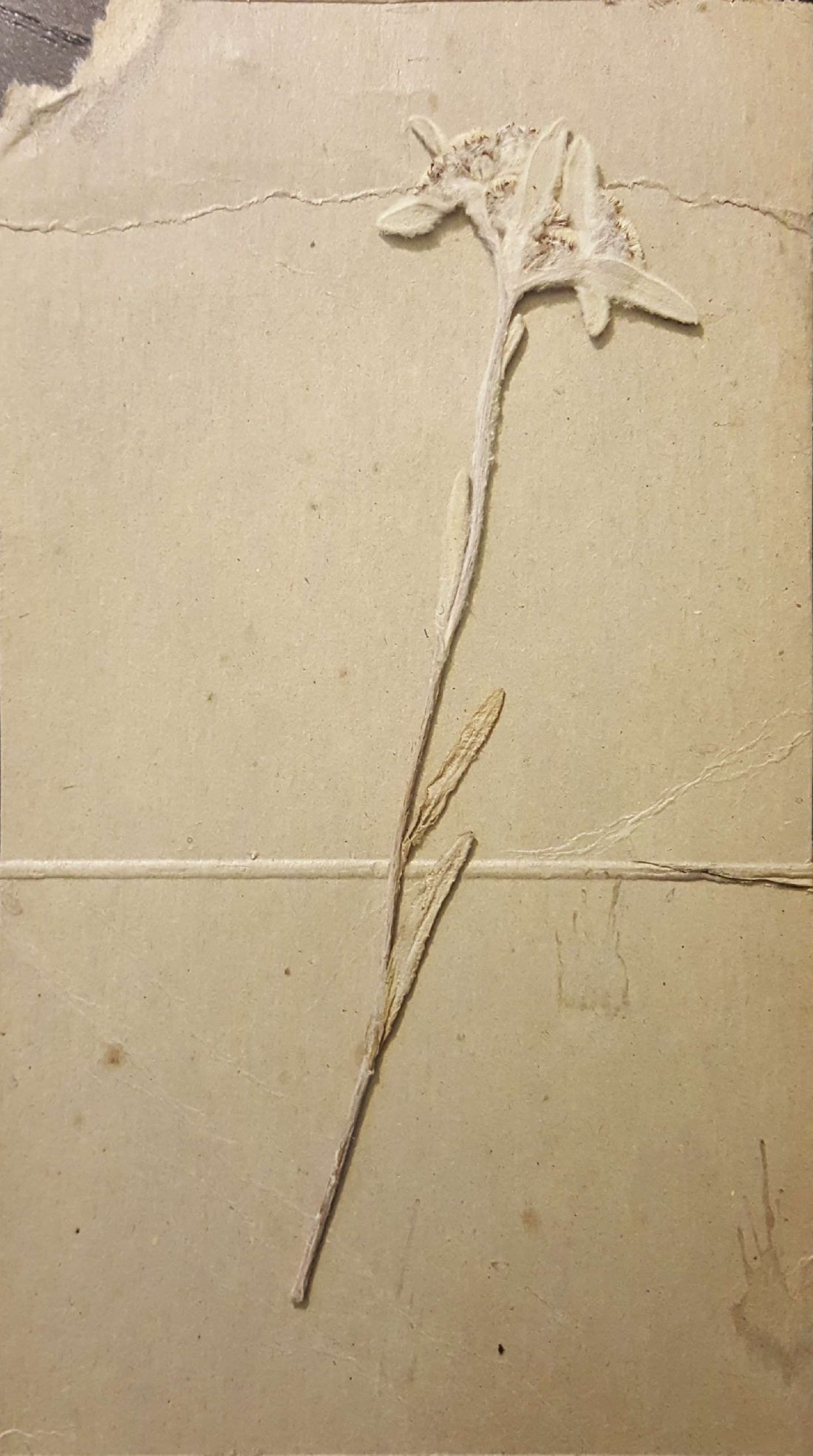
The day before, he had written about a flower. "I hope to enclose an Edelweiss flower for you if I do not forget. There is quite a tale connected with those flowers in this section. They grow way up in the mountains on the rocks. So! When a gay young blade wishes to impress his lady love he climbs one of these mountains and brings her one of these flowers."
"It sure was a long tiresome climb taking a couple of days for me to get up there. But the reward is well worth it. To send it to my lady love. Yes-sir I went up to the third floor of the building and found it in one of the botany books." He carried quite the sense of humor in his writings at times.
The Edelweiss is still with the letter, pressed flat, together with two pages from a German botany book, one of them carrying a photograph captioned Edelweiß.
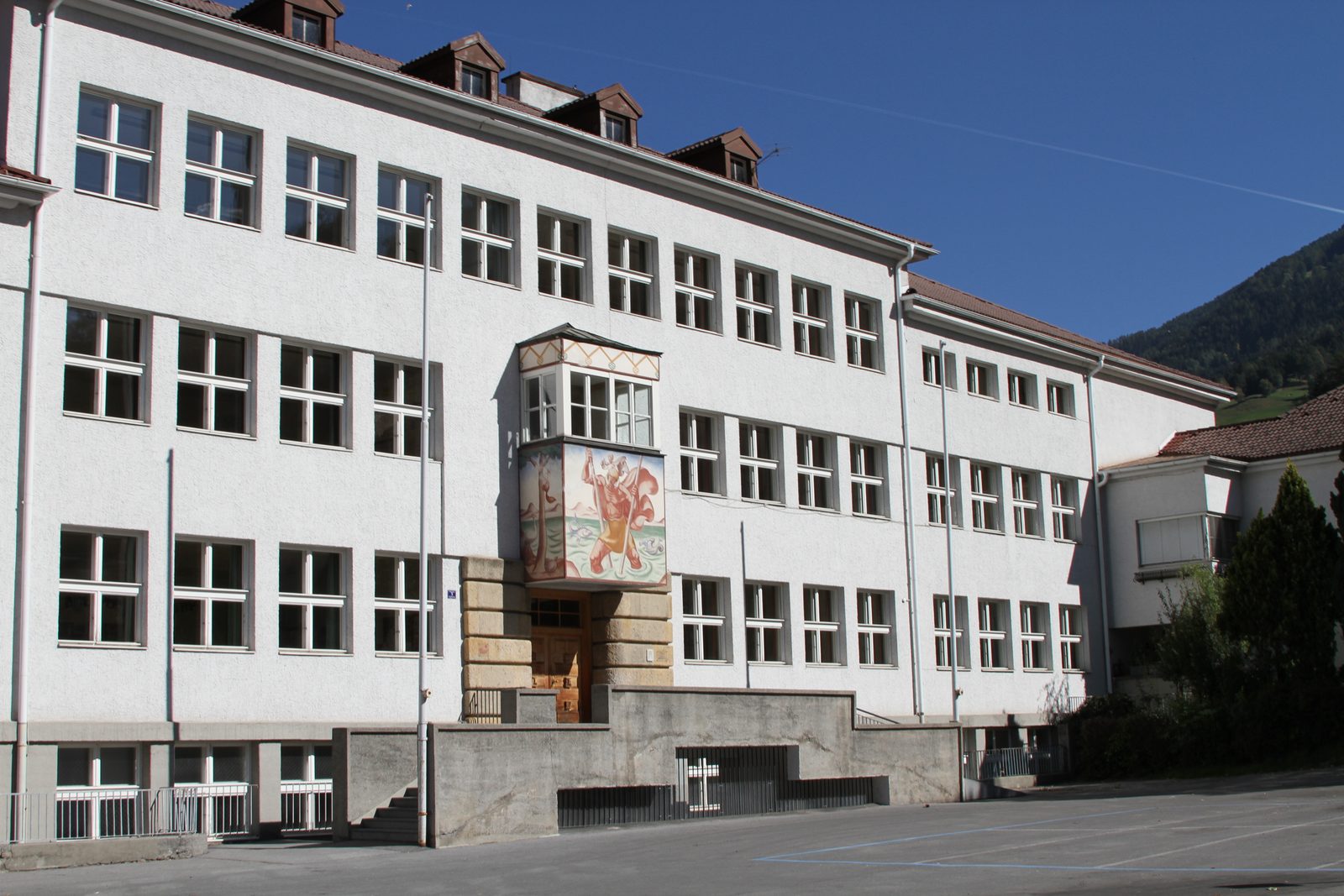
From the postcard, we found the church, that was not difficult thankfully. After visiting the church, we got our bearings, and headed in the direction of the school. Looking closely at the postcard, you can see there is space to the right of the building, meaning there are no buildings right next to it. You can also tell the size of the building, shape, and the open lot in front of it are the same. I also looked up on the internet to verify what the building was named and it was the Bundesrealgymnasium Landeck, the town's high school in 1945, now known as the BRG/BORG Landeck. With the stores closed, he could not buy anything there, though I'm sure he thought of bringing something home for my grandma.
The barracks
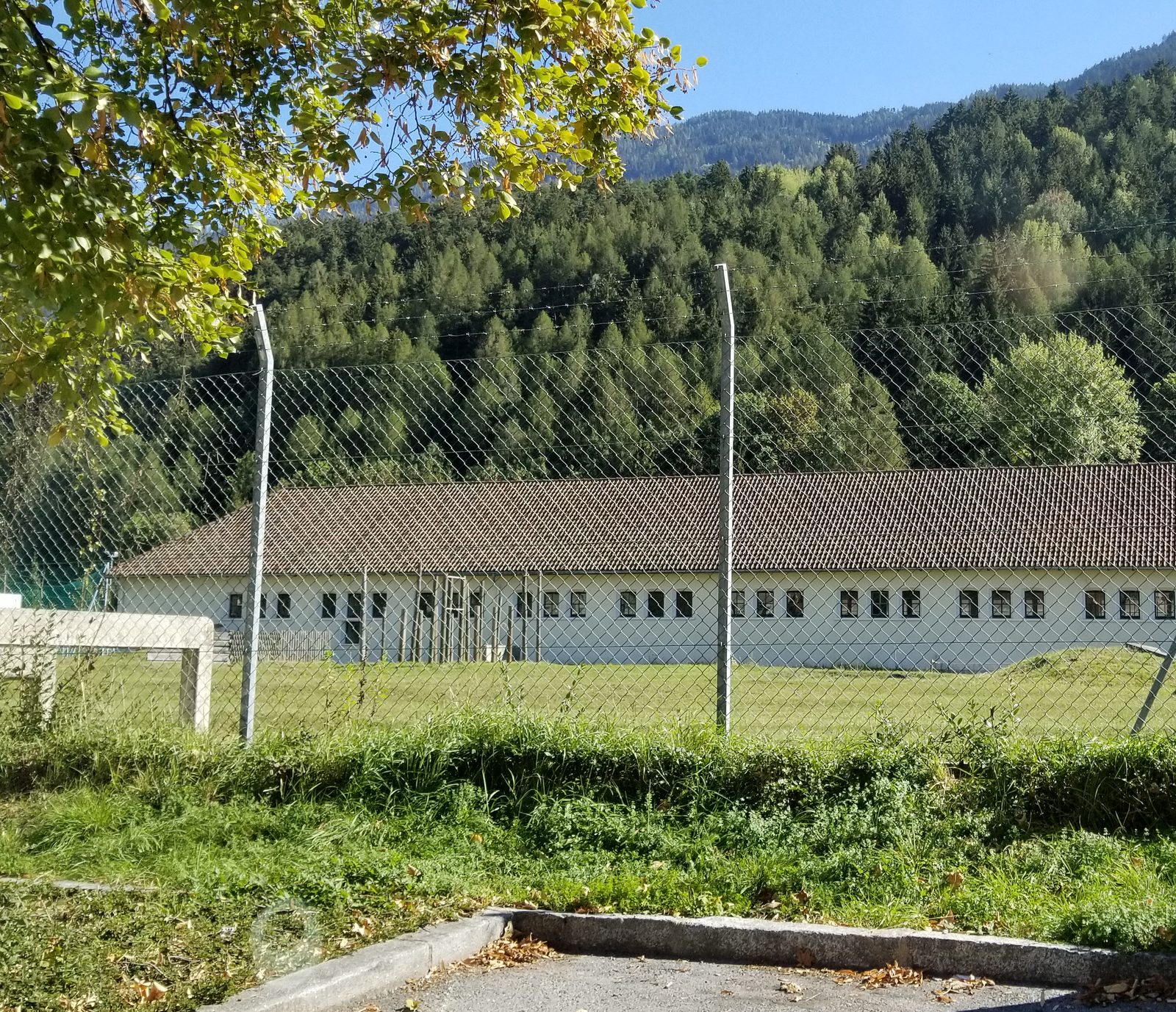
On 19 May he wrote that they had moved "to the barracks that are shown on the left hand side of picture no. two" — postcard no. 2.
Landeck still has an army barracks, the Pontlatz-Kaserne, and we drove past it on Urichstraße. I again used the postcards to gauge the river, the roads, the formation of the buildings. I verified it still existed online again, and found that I was in the right place again.
The view
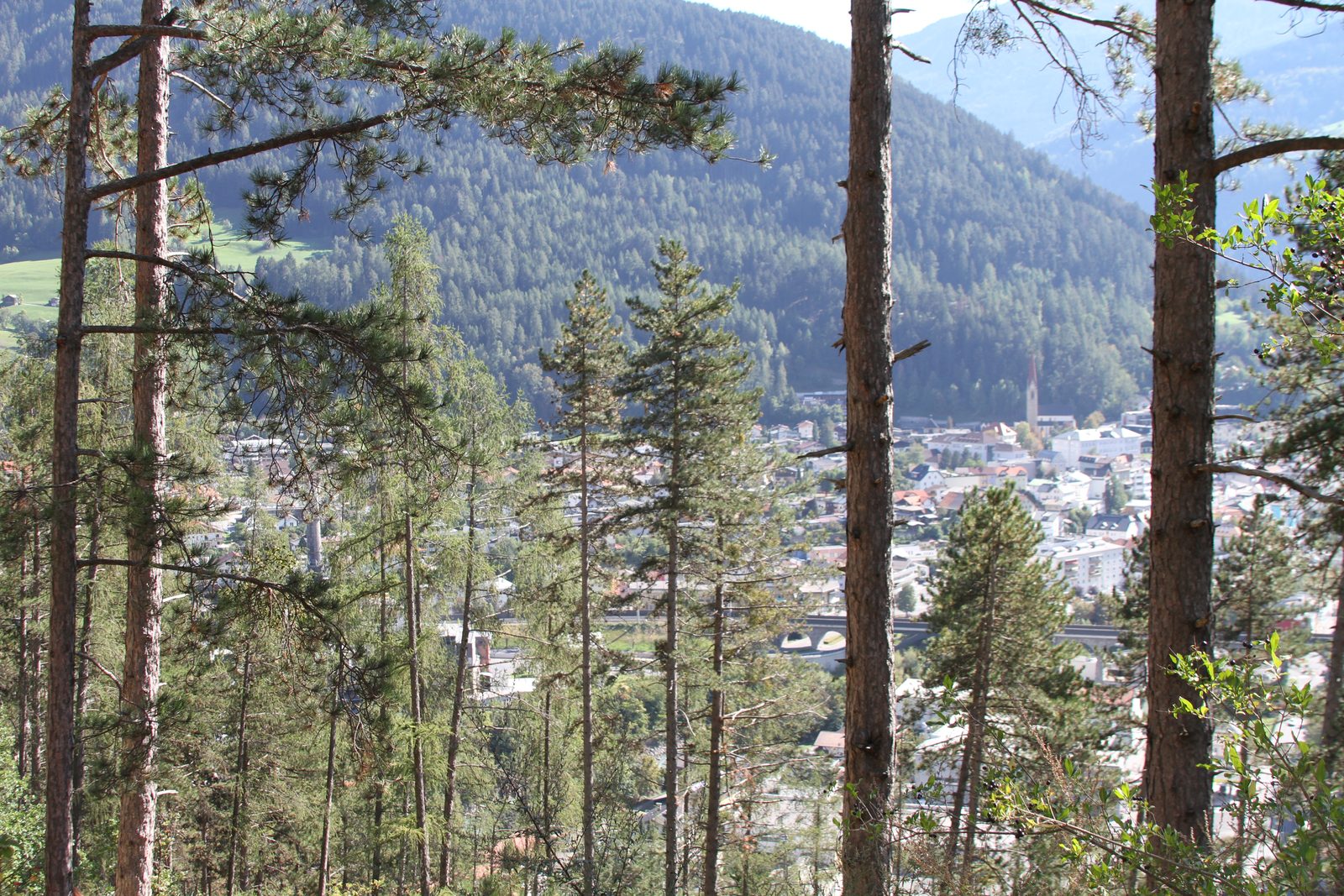
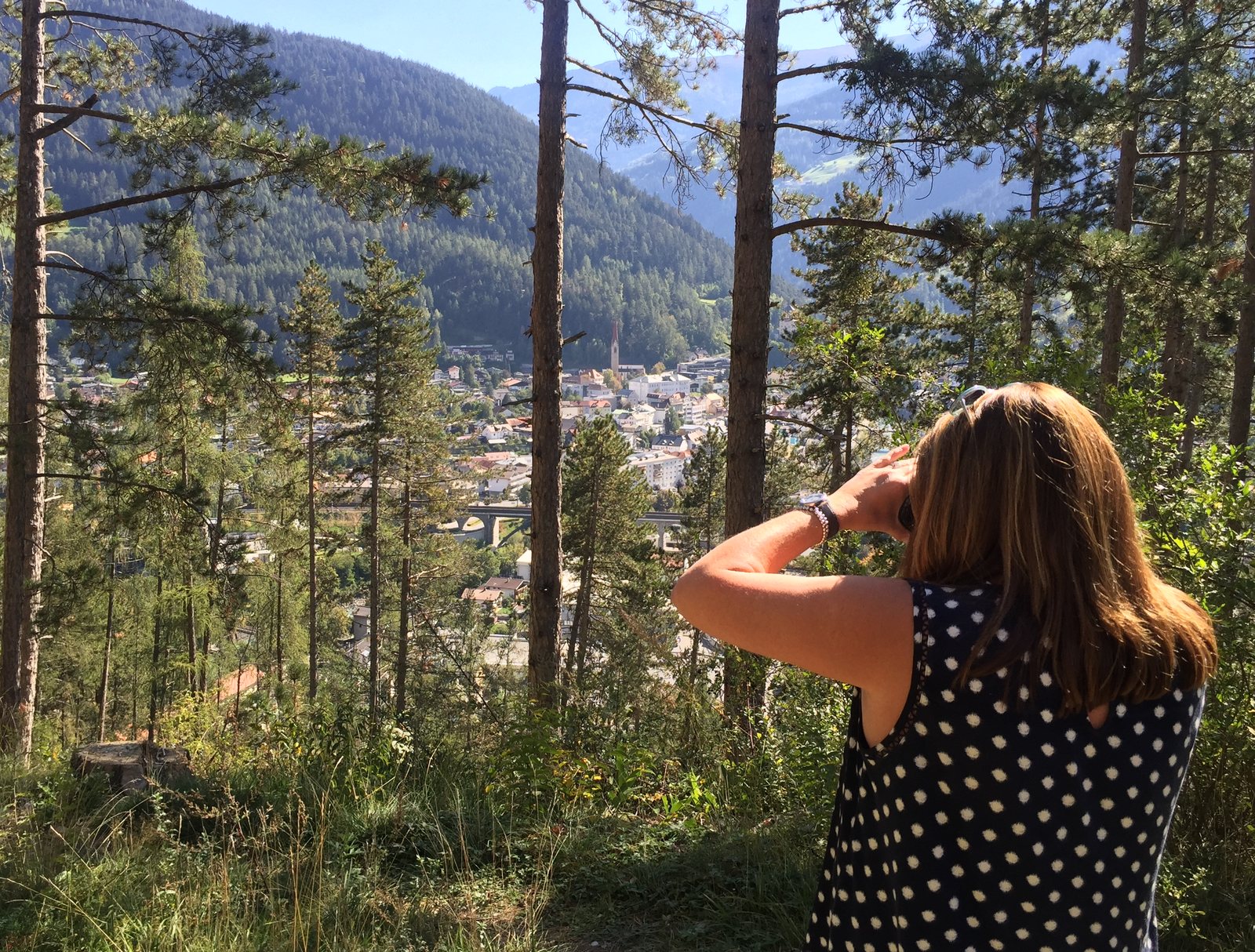
The church, the school and the barracks, those as a group, were easier to find, versus a view in a postcard from a hilltop, but we did it. We drove through town again, headed up the hill on Leitenweg, stopped several times, jumping out of the car looking at the view, deciding that wasn't it, back in the car again. Finally we got to a small street to the right, Lochbödele; we took it to the end, a dead end street with a small park at the end. This is where we found the view. The castle to the right of the church, the church steeple in the distance, the barracks to the right, the school to the left of the church.
Where the roads part
His road went south from Landeck, over the Reschen Pass into Italy. Ours went west. Liechtenstein and Vaduz Castle; the castles of the Domleschg in Switzerland, Ortenstein, Hohenrätien and the ruin of Oberjuvalt; the temperature falling from 77°F to 57°F through the mountains; Castello di Mesocco on its cliff; making our way down to Lake Como.
We ended on Lake Como, as planned. Stopping in Landeck allowed me to link part of my grandpa's history with my travels. I was able to see a place he described in letters and I experienced a brief stop during travels with my husband and friends. It was amazing to be in a place thousands of miles, separate continents, in a place that he was, I thought of that often during our drive to Lake Como. In hindsight I would have planned more time here, I would have stopped inside the church, stayed a day to see the shops open, learn more about the town at that time.
If you are planning a heritage trip
A trip like this is better for the research you do before you book it.
- Read what the family already holds. Letters, postcards, the backs of photographs, a prayer card, a discharge paper in a drawer. My whole stop came from one postcard.
- Find the town, not just the country. "Ireland" or "Germany" is a plane ticket. A townland, a parish or a village is a place you can stand in. That is usually a research question in its own right, and it is worth answering before you choose where to stay.
- Know what is still there. Churches get rebuilt, parish offices keep short hours, and archives often need an appointment made weeks ahead.
- Leave room. A conversation with the parish secretary or a stop at the local cemetery can take the whole afternoon, and it should be allowed to.
- Take the paper with you. Stand where the postcard was taken and hold it up.
Letters, a postcard or a discharge paper in a drawer? Start a conversation about what they could lead to — the first one is free.
The Block, by email
We're always turning new corners on The Block, subscribe to receive new posts from The Block when they are posted.