SALTPRINT Genealogical research &
Heirloom family books · Chicago
Client login

We find what was kept, and prove what it shows.

A Chicago-based genealogical practice. Documented research at five levels, and a bound heirloom volume at the end of it.
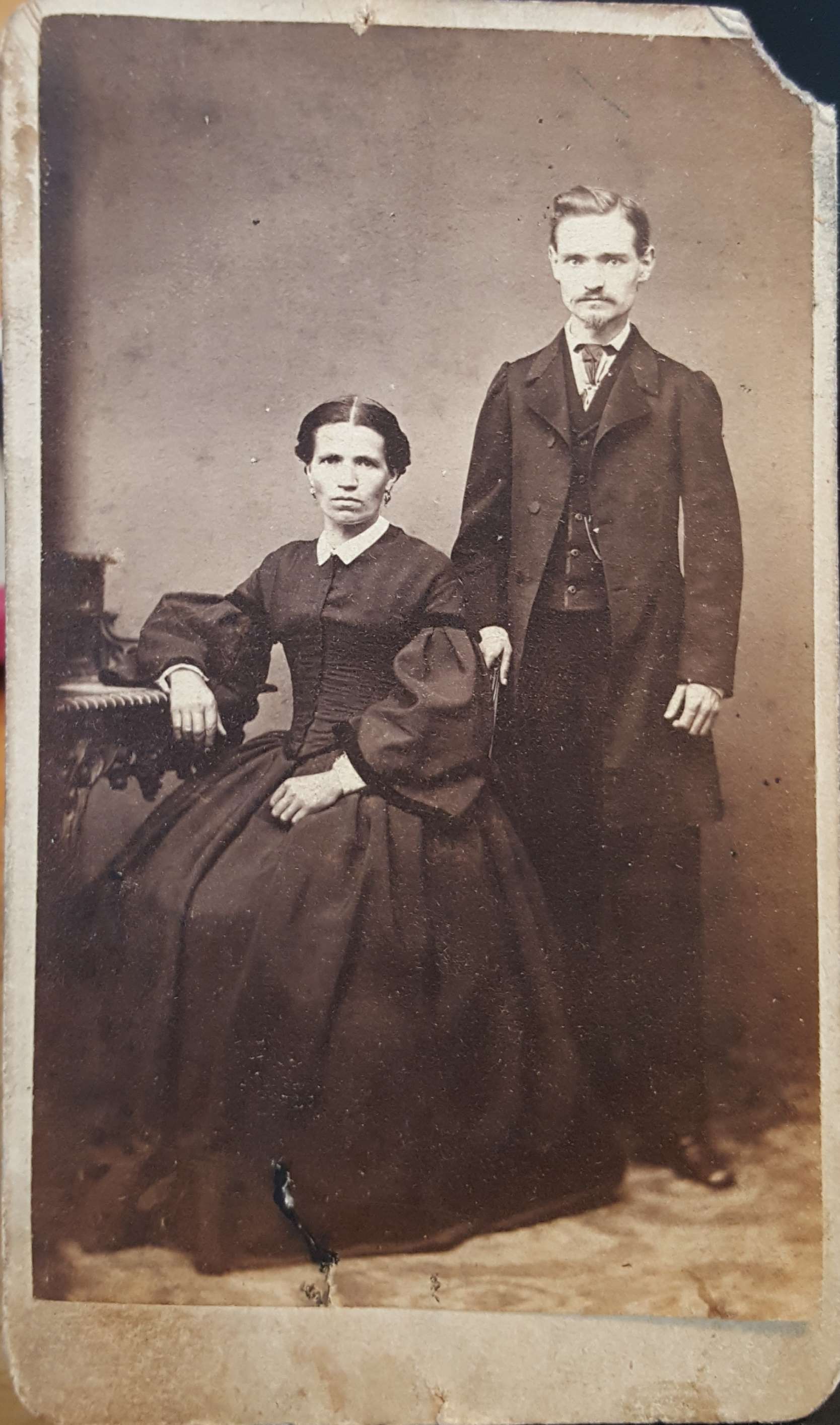
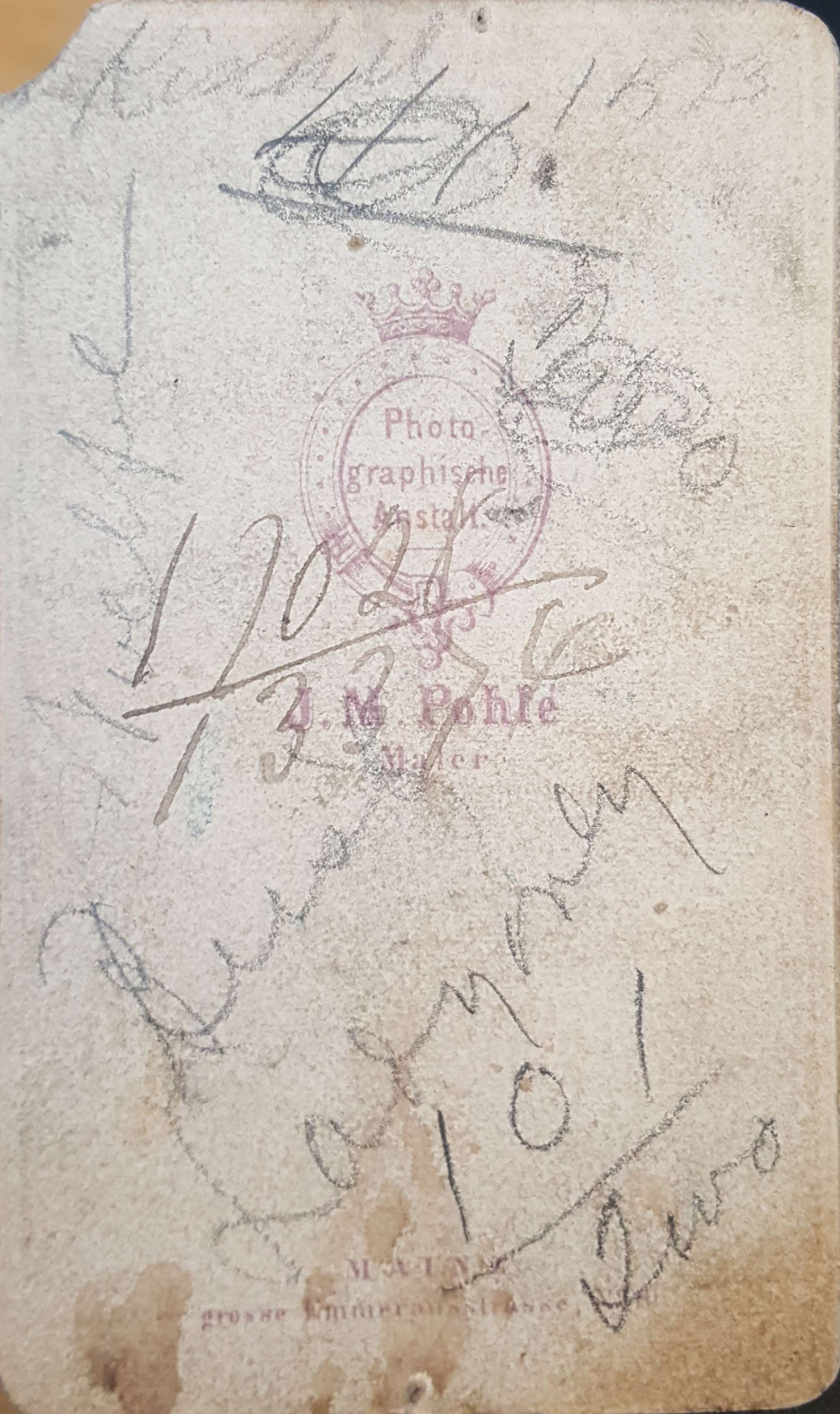
A carte de visite of a seated woman and a standing man, both in dark clothing, photographed in a studio against a plain backdrop. She rests one arm on a carved table; he stands beside her with a hand at her shoulder. The card's mount is worn at the corners and stained along the lower edge. The back of the same card, worn and foxed. A photographer's printed emblem sits in the middle — a crown above an oval reading Photographische Anstalt, and beneath it the name J. B. Pohle, Mainz. Across and around it, several different hands have written in pencil: names, numbers and what may be dates, overlapping each other and mostly illegible.
A carte de visite of Christian and Catherine Eichenold, made in Mainz, Germany — the front, and its back. The printed part is the photographer's. Everything else was added later, by more than one person, and none of it says who is on the front.

Most families have a box. An album with corners coming loose, a folder of certificates, a name someone wrote on the back of a photograph and never explained.

That box is evidence, and it is almost never enough on its own. The work is establishing what it actually proves — which names hold up against the record, which are family tradition, and which are simply wrong. Then finding the documents that fill what is missing.
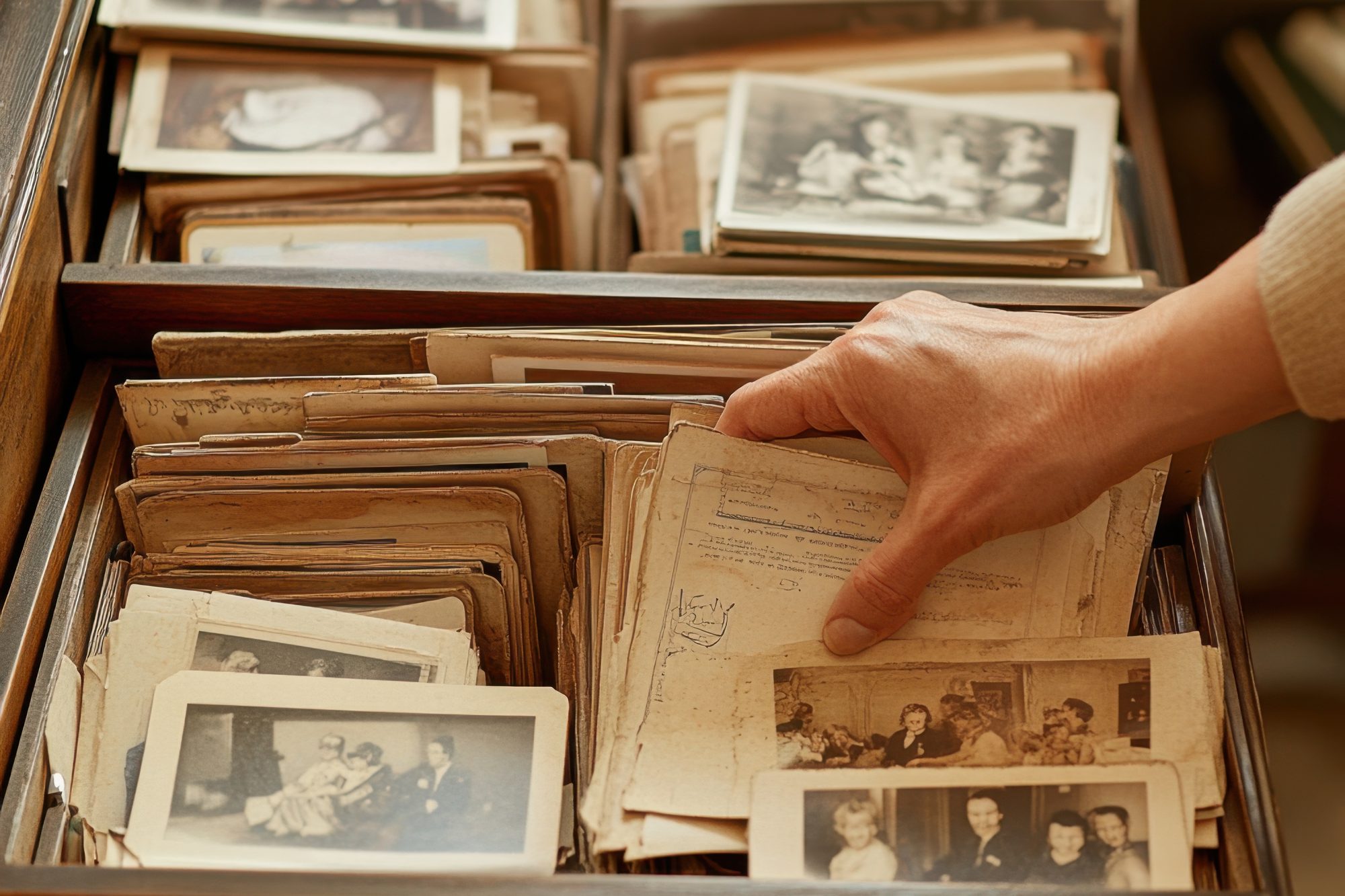
An open wooden drawer of family papers, part-sorted. A hand lifts a folded document covered in faded handwriting. Around it, black-and-white photographs lie loose among stacks of letters and cards, several still in card mounts with worn corners. A second drawer above holds more of the same, packed upright.

How far back?

It is the first question everyone asks, and the hardest one to answer with a price. As far as the records allow is a hope rather than a plan — it gives neither of us anything to hold on to, and it is how a project quietly becomes open-ended.

So the depth is settled in advance and does not move. In every book we work toward your great-great-grandparents — up to sixteen people, born for most American families somewhere between 1800 and 1860, which is exactly where the records begin to thin and the work slows down. Settling that line before we begin is what lets me give you a real figure rather than a guess.

What you choose is width. How many of your ancestors should your book take in?

Some lines stop whatever the budget — adoption, unknown parentage, records that burned. The book says which of yours were reached, which were not, and why.

If you want one line followed further, to the ancestor who crossed the ocean or the one who fought in a war, that is a Deep Line Extension and it is quoted on its own.

Level 1 is not shown — a report answers a question rather than tracing a line, so it has no width to draw. Each fan widens as it comes inward because a single grandparent stands in front of four great-great-grandparents.

The five levels

Not every family history starts with a book. Some start with a single question, or with a DNA result nobody has been able to make sense of. Level 1 exists to break one specific deadlock — a single defined question, answered and documented.

Level 1 — A written report

Level 1 exists to help solve specific research mysteries or brick walls encountered in your family history. One defined question: a contested link, an unidentified person, a difficult origin to confirm, a common-surname conflict, or a DNA result nobody can make sense of.

Covers a question, a record set, or a DNA result · not a line traced  ·  You receive: Written report, PDF, fully cited

Focused research report · Level 1-B
What was the maiden name of Catharina, wife of Christian Eichenold, and where in Germany did the family originate?
The answer, in one sentence

Wölfing, established by two original records that name her mother: her own 1828 baptism and her 1859 marriage, both at Rauenthal. Catholic, from Rauenthal in Nassau and Aschaffenburg in Bavaria.

What the family believed Maiden name Binder or Singer — Discarded Lutheran — Contradicted: Catholic From Vielbrunn, Odenwald — Contradicted: Rauenthal Married about 1853 — Contradicted: 17 Oct 1859 Emigrated in the 1860s — Verified: 1866
The first page of a Level 1 report from my own family's research.

Level 2 — The Couple Study

One ancestral couple, followed from meeting to grave. Two of your sixteen great-great-grandparents, and the one great-grandparent they share. The smallest object that is still a book rather than a report.

Covers One ancestral couple · 2 of your 16  ·  You receive: Bound volume

Level 3 — The Targeted Book

One grandparent’s line, a quarter of the fan. Four of your sixteen great-great-grandparents. The usual starting choice when one side of the family is the side with the more questions in it.

Covers One grandparent’s line · 4 of your 16  ·  You receive: Bound volume

Level 4 — The Heirloom Book

Both grandparents on one parent’s side — half the fan, eight of your sixteen great-great-grandparents. A whole parental side, maternal or paternal, of the family in one volume.

Covers Both grandparents on one parent’s side · 8 of your 16  ·  You receive: Bound volume

Level 5 — The Comprehensive Saga

All four grandparent lines. The whole fan, filled to the outer ring: sixteen great-great-grandparents, as far as the records reach. Delivered as one volume or two, depending on what the research turns out to hold.

Covers All four grandparent lines · all 16  ·  You receive: Bound volume, one or two

Every conclusion is sourced. Where the record contradicts the family story, you are told, and you are shown why. The full comparison is on the Research page.

How the work runs

There is no lengthy proposal process. Four steps, and you are not left waiting until the end to see what you bought.

What you leave with

A clear sense of what your material is likely to support, and which level fits it. No obligation either way.

What you leave with

A fixed figure in writing — not an estimate, not a range — with the lines named and the exclusions stated.

What you leave with

One agreement, signed once, with your scope attached to it and the review checkpoints written in.

What you leave with

A midpoint look at draft chapters while there is still time to redirect, and a final review of the laid-out volume before it goes to print.

Chicago, specifically

1

A great deal of this city’s paper burned in 1871, and a great deal more was never filed in the first place.

2

The streets were renumbered in 1909 and again in 1911, so an address before those years is not the address you would look for now.

3

Parish registers outlived the civil ones, and the school and ward records survived because they sat outside the fire’s path.

Working here means knowing which substitutes exist. That knowledge is the difference between the records are lost and an answer.
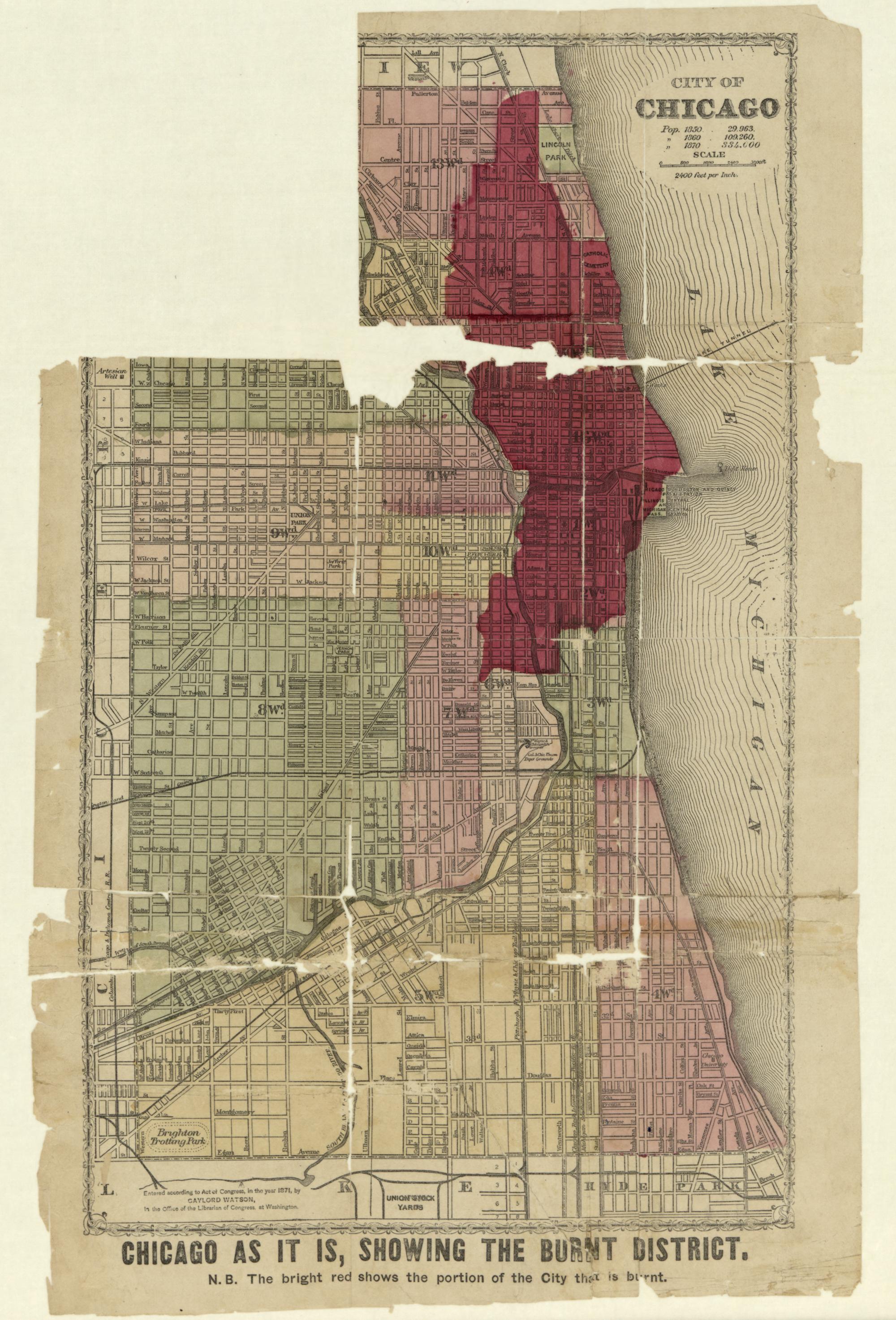
A ward map of Chicago from 1871, torn, folded and browned with age, with the area destroyed by the fire printed in bright red running north to south along the lake shore. The remaining wards are numbered across the rest of the city. A banner along the foot reads: Chicago as it is, showing the burnt district.
Chicago as it is, showing the burnt district — Gaylord Watson, 1871. The red is what burned. The numbered wards across the rest of the sheet are where the substitutes are.Library of Congress, Geography and Map Division. Public domain by date of publication.

And not only Chicago

Chicago is where I work from, not the limit of what I work on. The research behind this practice runs across the United States coast to coast and back into the British colonies, and out again into twenty-six countries — my own families, my husband's, and the families of friends who became the first clients.

What that has actually involved: German and Nassau parish registers, Icelandic and Scandinavian farm records, Irish and English parish and civil registration, passenger manifests out of Le Havre and Bremen, colonial-era land and probate papers, military service and pension files, and orphanage and children's-home admission records — the kind held by an institution rather than a county, and reached by asking the right archive the right question.

Reflections

Nothing is published here yet. The first quotation goes in the day a client sends one and agrees in writing to the name it appears under — verbatim, never paraphrased, composed or improved.


Almost nothing of Chicago's photographic record survived the fire. What did survive, survived because a family kept it.

Start a conversation

The initial consultation is complimentary and takes about 30 minutes.