The Block · PUBLISHED 5 SEPTEMBER 2026
What actually burned in 1871
The fire is the first thing anyone says about Chicago records, and it is the least useful thing they say. The useful question is narrower — which office held the record you want, and did that office stand inside the burnt district.
Tell someone you are researching a Chicago family and you will hear about the fire within a minute. It is usually offered as a closing argument. The records burned — meaning stop, meaning there is nothing to find, meaning the line ends in October 1871 and no amount of money will move it.
That is true of a narrow and specific set of records, and false of a great many more. The difference between the two is the whole job.
The burnt district was a shape, not a city
The fire ran roughly four miles north from Taylor Street along the lake, and about three quarters of a mile wide. That is a large piece of Chicago and it included the part that held the county's paper. It is not Chicago.
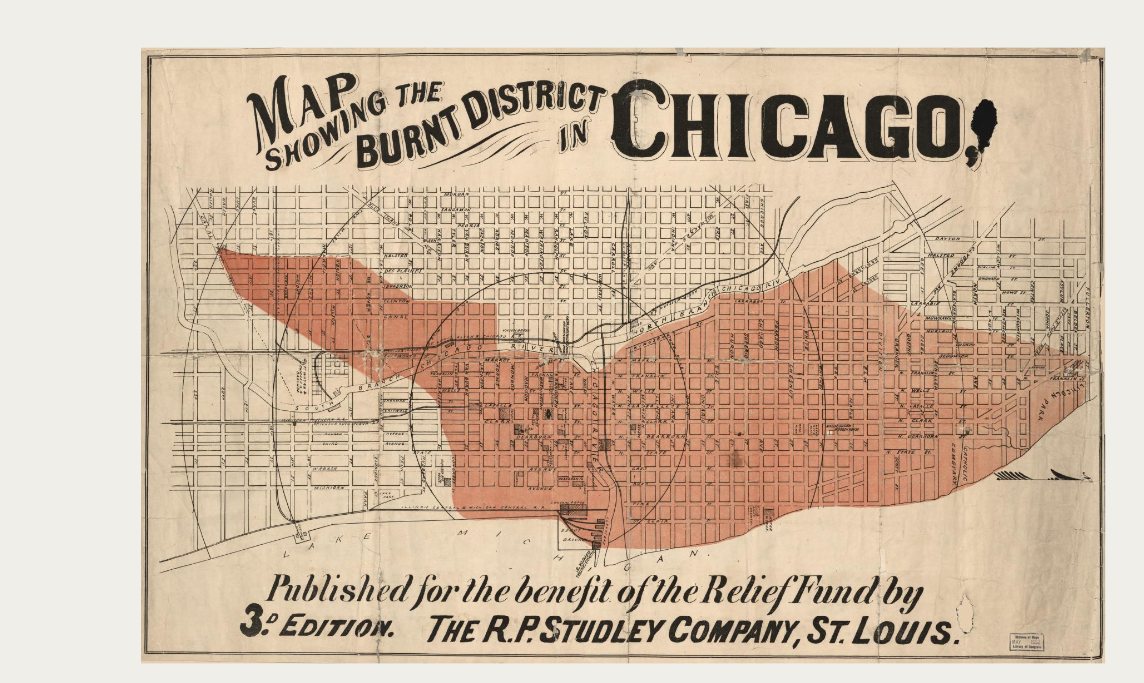
The map is the one to hold in your head, and the useful part of it is the white. The red is the burnt district. Everything outside it stayed standing, and that is where the substitutes are — parishes that never filed with the county in the first place, and institutions whose buildings stood beyond the line.
So the question is never did the records burn. It is:
- Which office was supposed to hold this record in that year?
- Where did that office physically stand?
- Did anyone else hold a copy, for their own reasons?
The third question is the one that pays.
What was genuinely lost
The Cook County courthouse went, and with it the county's own civil registration — births, marriages and deaths filed with the county before October 1871. Land records in the recorder's office went the same way. Probate files went. Naturalization records filed in the county courts went.
That is a real loss and it should be stated plainly rather than worked around with optimism. If your question is what does the county's 1868 birth record say, the answer is that there is no county birth record for 1868 and there will not be one.
What did not
Church registers. A parish kept its own book, in its own building, for its own purposes. Catholic baptismal and marriage registers across the city survive in quantity, and for a German or Irish or Polish family in the 1850s and 1860s the parish book is frequently better than the civil record would have been — it names godparents, and godparents are relatives.
Records held elsewhere. Federal census returns were not in Chicago. Passenger manifests were filed at the port of arrival. Military service and pension files sat in Washington. Emigration files sat in the archives of the country the family left. None of that was ever within reach of the fire.
Records made afterwards about before. This is the category most people never think of. A death certificate from 1904 states a birthplace and often a birth year and parents' names. A delayed birth certificate filed in 1937 by someone who needed proof of age for Social Security reaches back sixty years. A probate file from 1890 names the children. An obituary names the surviving siblings and where they had moved to.
Institutional paper. Orphanages, children's homes, hospitals, schools, benevolent societies, insurance companies, employers. These kept admission books and membership rolls because they had to run themselves, and a surprising number of those books still exist in an archive somewhere, cataloged under the institution's name rather than under anybody's surname.
What this means for a family
It means the fire changes the route, not the destination. A pre-1871 Chicago ancestor is usually reachable — through the parish, through what a later record says about an earlier life, or through the country of origin. It takes longer than it would in a city that did not burn, and the citation trail is more complicated, and sometimes the answer arrives as a well-supported inference rather than a single document that says so outright.
And sometimes it does not arrive. Adoption, unrecorded parentage, a family that arrived and left again inside a decade — those stop for their own reasons, and the fire gets blamed for them unfairly.
The fire is a reason certain records do not exist. It is not a reason to stop looking, and it is very rarely the reason a particular line actually ends.
What a report or a book should tell you is which of those two you are looking at: a line that stopped because the paper burned, or a line that stopped because the search has not yet gone where the paper went.
Working on a Chicago family and stuck on something like this? Start a conversation — the first one is free.
The Block, by email
We're always turning new corners on The Block, subscribe to receive new posts from The Block when they are posted.