About
Born and raised in Chicago, in a family that has had roots here since 1866 — and fortunately a family that kept its photographs and records.

Both sides of our family came from Germany, Sweden, Iceland and Lithuania. Two of my mother's ancestral families immigrated from Germany and had been living in Chicago since 1866 and 1868 — so they were already here when the city burned in 1871. Which means the records I work in professionally are the same ones I grew up inside, and so are the gaps. My father's side took the longer road once in America: through Michigan and Philadelphia in the 1850s, and Chicago only in late 1910.
I have been fortunate in a way most families are not. Both of my parents inherited photographs, records, family memorabilia, some dating to the early 1860s, and in a great many cases somebody wrote a name on the back. That is rarer than it sounds. Most boxes hold faces nobody can identify any more.
So I have spent years doing the thing those unknown photographs ask for: connecting them to the record. Birth, marriage, immigration, death — finding the documents that turn a face and a penciled name into a person with a life you can follow. My own family, friends' families, and a particular preoccupation with the ones nobody can put a name to. The faces that came down with nothing written on the back. The houses no one recognizes. The photograph that has to be from a particular decade because of a collar, or a doorway, or a street that was renumbered in 1909.
That is the part I love — digging until there is enough to tell somebody's story properly, and saying plainly where the evidence runs out.
Saltprint exists to do that work for other families. Yours has its own box, its own unexplained handwriting, its own people nobody has been able to place. I would very much like to help you find out who they were.
Start a conversation · Questions
Why the practice is called Saltprint
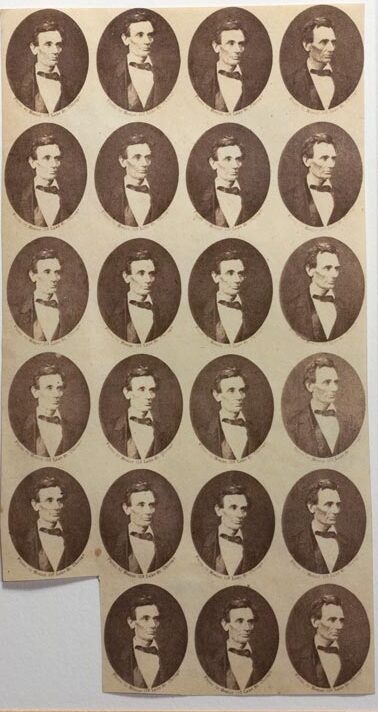
The name takes one sentence to explain, and it is worth the sentence.
A salt print is the oldest kind of paper photograph: plain paper coated in salt and silver, printed by the sun. It was the medium of Alexander Hesler, the finest photographer working in Chicago in the 1850s, who made thousands of salt prints of Abraham Lincoln for the 1860 campaign.
Almost nothing of Chicago's photographic record from those years survived the fire of 1871. What did survive, survived because a family kept it — in an album, a drawer, a box nobody threw out. That is where this work begins. We find what was kept, establish what it actually proves, and bind it into a volume built to outlast the people who commissioned it.
The process itself is a fair description of the practice. A salt print is slow, made by exposure rather than development, and it cannot be rushed without failing. It also lasts — properly made and properly stored, longer than most of what replaced it.
It is not a coincidental name. A practice that began in a box of photographs nobody could identify was never going to be called anything else.