The Block · PUBLISHED 16 OCTOBER 2026
Before the plane ticket
If you are in your twenties and curious about where your family came from, you are in good company. Before the DNA kit and the plane ticket, there is a phone call to make.
Last week I wrote about the questions I didn't ask my grandparents, and how late I understood that they were the last people who could answer them. This one is for the people who still can.
You are already curious
If you are in your twenties, you may care about this more than you'd guess from how rarely it comes up.
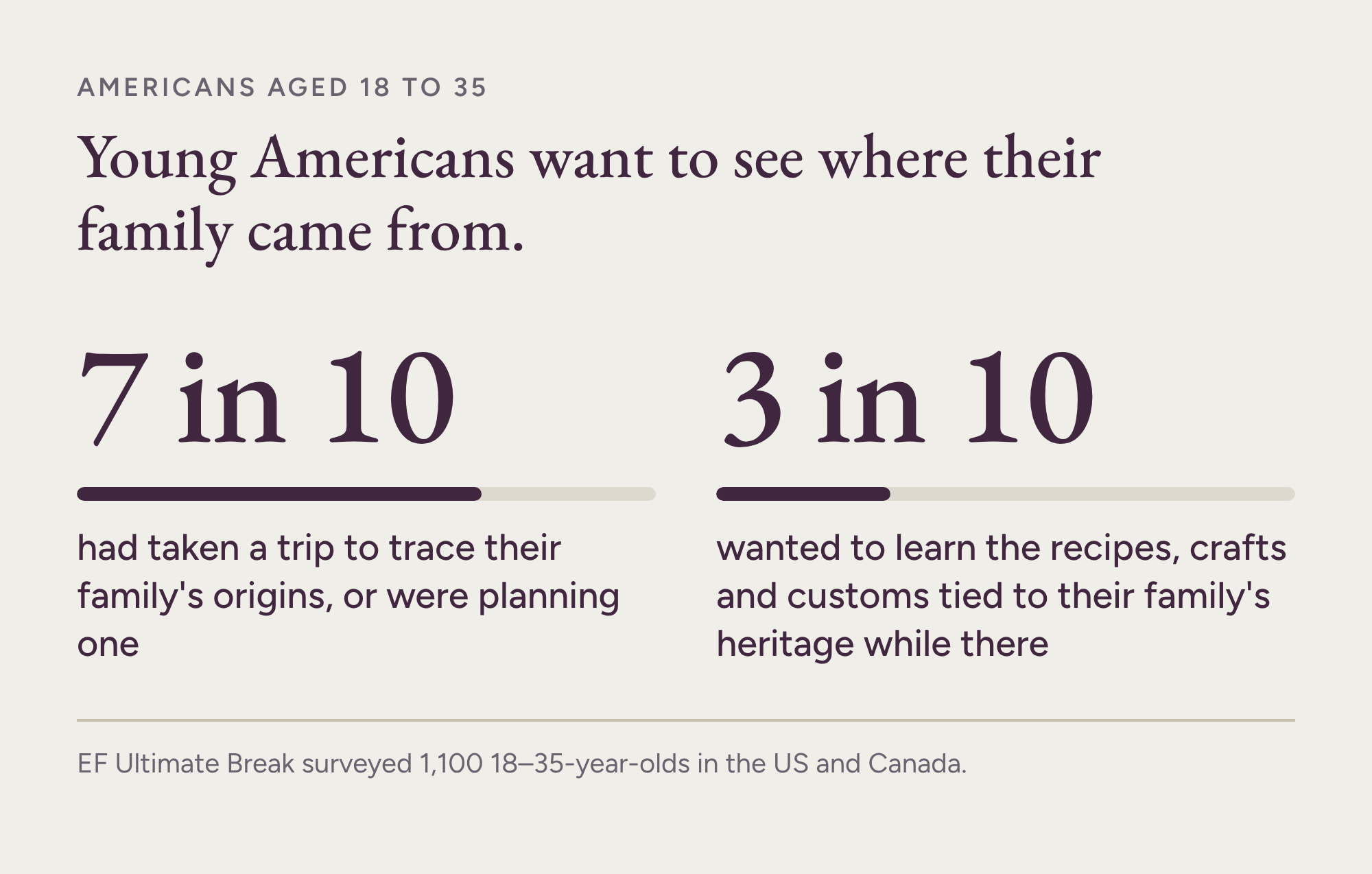
You can see the same pull everywhere else. DNA results get opened on camera. Apps animate a great-great-grandmother's photograph so she blinks and turns her head. And this spring the internet named a trend nonna-maxxing: young people cooking like their grandmothers again — the homemade pasta, the long Sunday table, the recipe written on a card in someone else's handwriting.
That curiosity is real, and it is the right instinct. But notice where most of it points: at a place, a test result, an idea of a grandmother. Your actual grandmother, if you still have her, is a phone call away. She may know the name of the village. A DNA test can give you a region and a list of distant cousins. It has never told anyone why their family left.
The part only you can do
If your grandparents are alive — or your parents, or a great-aunt who remembers everyone — the most valuable research you will ever do costs nothing. It doesn't have to be a formal interview. It rarely goes well as one.
- Bring something to look at. A shoebox of photographs does more than a list of questions. Write names on the back, in pencil, while someone can still tell you them.
- Do something together. Cook the recipe with them. Drive past the old house or the old parish. People remember more with their hands busy and a place in front of them.
- Record it. Ask first, then turn on the voice recorder on your phone and leave it running. The voice is worth keeping for its own sake, and you will not remember the town name later.
- Ask the next question. When they say he came over from the old country, ask which country, which town, which year, who came with him, and what caused him to leave.
- Go back. One afternoon opens a memory that shows up the next time you visit. Make it a habit, not an event.
If you want somewhere to begin, the questions I would ask are a start.
No archive replaces that conversation. Memory is not proof — people misremember dates and places all the time, and part of my work is checking a family's stories against the record. But a remembered town name is often the one clue that tells a researcher where to begin. Without it, a search can spend months in the wrong place.
The part you shouldn't do alone
The other half is the records, and there my advice is different.
Most people who start their family history on their own start the same way: a subscription, a tree, a few good evenings, and then a wall. A surname spelled four different ways. A record in a language or a handwriting they can't read. An immigrant who seems to appear from nowhere. A suggested ancestor, copied into hundreds of online trees, who turns out to be the wrong person.
Getting past those takes knowing which archive holds what, how a given country kept its registers, and how to tell two men with the same name apart. It can be learned — I learned it — but it took years, and years are exactly what you may not have with the people who can help you read the records.
The records will still be there in ten years. The people who can tell you what the records mean may not be. So spend your time on the conversations now, and let someone who does this every day spend theirs on the archives.
Where to start
This week, not someday. Call, and ask one question. Write down the answer.
When you are ready to go further, you don't need to commission a whole book to begin. A single research question — where in Germany did they come from, who were her parents, why does he disappear after 1880 — is often the right first step, and the answer tells you whether there is a larger story in the records. It may even tell you which village to put on the itinerary. It may even give you more information to "Go Back" and have more conversations with the ones that might fill in more gaps.
Planning a trip to where your family came from? Start a conversation before you book — the first one is free.
The Block, by email
We're always turning new corners on The Block, subscribe to receive new posts from The Block when they are posted.