The Block · PUBLISHED 3 NOVEMBER 2026
Ask where everyone is buried
If you ask an older relative one question, ask where everyone is buried. It sounds morbid. It is the most practical question in family research.
If you ask an older relative one question, ask where everyone is buried.
It sounds morbid, and people sometimes hesitate to ask it. It is the most practical question in family research, and it is one of the three small things we suggested earlier this fall. A relative who cannot tell you a great-grandmother's birthplace can often tell you, without stopping to think, that she is at St. Boniface with her husband, near the fence.
Why a cemetery is a good witness
A cemetery kept records for a reason of its own. It sold the lots, it dug the graves, and it had to know who was buried in each one and who owned the ground. That is a business record, made at the time, by someone with no stake in the family's story.
What it holds varies by cemetery and by decade, but an interment record commonly gives the date of burial, the age, the last address and the funeral director. The lot card is often more useful still. It names the lot owner, usually the first of the family to die, and lists everyone else buried in that lot — including infants and young children who may appear in no other record at all.
The chain
A burial place is rarely the answer. It is the first link in a chain:
- The grave gives you a cemetery and, with luck, a section and lot.
- The cemetery office gives you the interment record and the lot card, and with them the other people buried alongside.
- The funeral often ran through a parish or a congregation, and the record may say which one.
- The parish register holds the burial entry, and from there the baptisms and the marriage.
- The marriage entry of an immigrant couple is one of the places a village of origin is most often written down.
None of those steps is guaranteed. A burial in Chicago before about 1870 may tell you only that someone was buried, because the old city cemetery in what is now Lincoln Park was moved, and the records of the removals are incomplete. But the chain runs often enough that the burial place is where a stuck line most often moves again.
When Chicago moved its dead
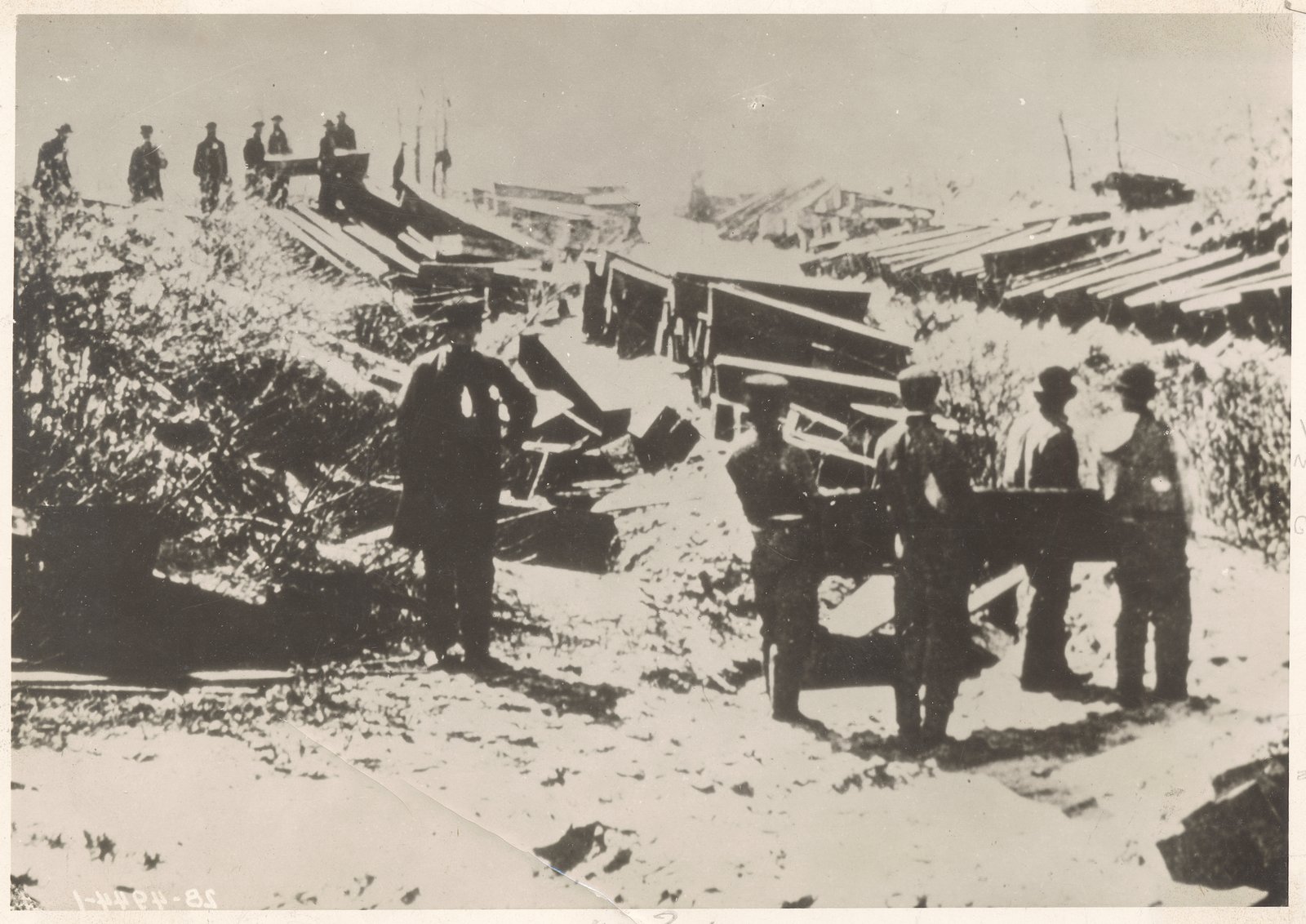
From 1843 until the late 1860s, what is now Lincoln Park was the Chicago City Cemetery. When the land was made into a park and named for Abraham Lincoln, the graves were moved to cemeteries farther from the city, among them Rosehill, Graceland and Calvary. The photograph shows that work in 1865 and 1866: coffins lifted out of the ground and stacked on the dug-up earth before they were carried away.
The removals took years, and the records of them are incomplete. Families who could pay moved their own dead. Others were moved by the city, and some were never moved at all: the Couch family tomb still stands in the park, behind the Chicago History Museum. So for a Chicago burial before about 1870, look for where the person went next. The later plot at Rosehill, Graceland or Calvary is often the record that names the family.
Chicago buried by community
Chicago's cemeteries were organized, more often than not, along the same lines as its neighborhoods.
Catholic families went to Catholic cemeteries — Calvary, St. Boniface, St. Adalbert, Resurrection and the rest — frequently chosen by language and parish as much as by geography. Jewish families were often buried at Waldheim in Forest Park, in sections owned by individual congregations, lodges and mutual aid societies, so the section itself can point to the town in Europe a family came from. Rosehill and Graceland took everyone.
Which means the cemetery is itself evidence. A family buried at St. Adalbert was, in all likelihood, part of the city's Polish Catholic community, and that tells you which parish registers to read first.
If nobody remembers
When no one living knows the cemetery, the death certificate usually does. Cook County death certificates generally name the place of burial and the undertaker, and both lead somewhere.
A headstone is not the record
The stone is worth a photograph, along with the stones on either side of it. But a headstone is often placed months or years after a burial, ordered by someone working from memory, and its dates can be wrong. Some graves never had one. The record in the cemetery office is the evidence. The stone is a clue.
So call the office before you visit, ask for the interment record and the lot card, and bring the section and lot number if you have them.
And this holiday season, ask the question. Write the answer down in the words you hear it in, including the part about the fence.
Know the cemetery but not much else? Start a conversation — the first one is free.
The Block, by email
We're always turning new corners on The Block, subscribe to receive new posts from The Block when they are posted.