The Block · PUBLISHED 21 NOVEMBER 2026
Ten questions your kids can ask their grandparents
The best family history project for a child costs nothing: an afternoon with a grandparent and ten good questions. Here they are, with how to keep the answers.
Thanksgiving is coming, and the most useful family history project a child can do costs nothing. It takes an afternoon, a grandparent, and a list of good questions.
Children ask questions adults stop asking. A grandparent who would wave off tell me about your childhood from a grown son or daughter will often answer a nine-year-old at length, because the child really wants to know what school was like with no computers.
The answers matter more than they seem to at the time. A grandparent who grew up in the 1950s or 1960s is often the last person who knew their own grandparents, people born in the 1880s and 1890s. One conversation can reach back more than a century.
The ten questions
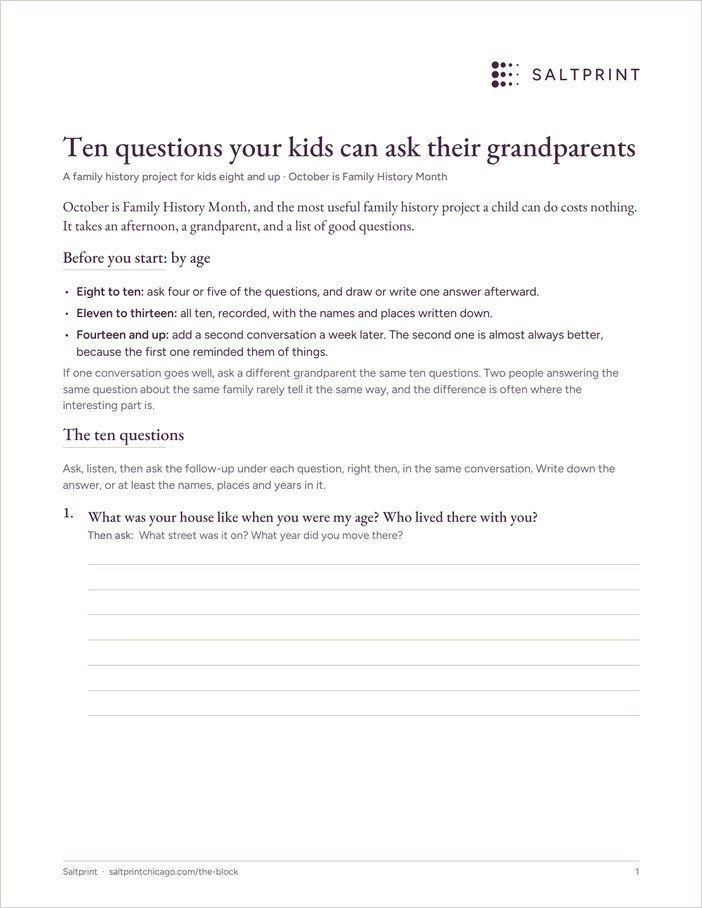
These work for children from about eight. Get the free printable worksheet: the ten questions with room to write, a sheet for names, places and years, and the by-age tips. Or let your child copy the questions out in their own handwriting.
- What was your house like when you were my age? Who lived there with you?
- What did you do after school? What games did you play?
- What was your school like? Do you remember a teacher's name?
- What did your family eat for dinner on a normal night? What about holidays?
- What did your parents do for work?
- Where did your parents and grandparents come from? Do you know the name of the town?
- What is the oldest thing in our family? Who did it belong to first?
- What was something you got in trouble for?
- How did you meet Grandma, or Grandpa?
- Who is in this photograph?
For the last one, bring a real photograph: one from a drawer, an album, or the back of a frame. It is the question that most often produces a name nobody else in the family knows.
The follow-up question
The answer that sounds like a story usually has a record behind it. When your child hears we lived over the bakery on the corner, the follow-up is which street, and what year? When they hear my grandmother came from the old country, it is which town?
Names, places and years are what turn a memory into something that can be checked and kept. Encourage your child to ask for them, politely, every time.
How to keep the answers
- Record it, with permission. A phone's voice-memo app is enough. Ask first, and say why: so it can be kept.
- Let your child do the asking. You can sit in, but the conversation goes better when it belongs to them.
- Write down every name, place and year on a separate sheet as it comes up, spelled the way the grandparent spells it.
- Label the photographs you talked about, on the back, in soft pencil: who, where, and roughly when.
- Keep it together. The recording, the sheet and the photographs belong in one folder, with the date of the conversation on it.
By age
- Eight to ten: ask four or five of the questions, and draw or write one answer afterward.
- Eleven to thirteen: all ten, recorded, with the names and places written down.
- Fourteen and up: add a second conversation a week later. The second one is almost always better, because the first one reminded them of things.
If one conversation goes well, ask a different grandparent the same ten questions. Two people answering the same question about the same family rarely tell it the same way, and the difference is often where the interesting part is.
A name, a town or a date came up that nobody can place? Start a conversation — the first one is free.
Free printable: Ten questions your kids can ask their grandparents
Leave your email and the printable opens on this page. You will also get a note when something new goes up on The Block.